

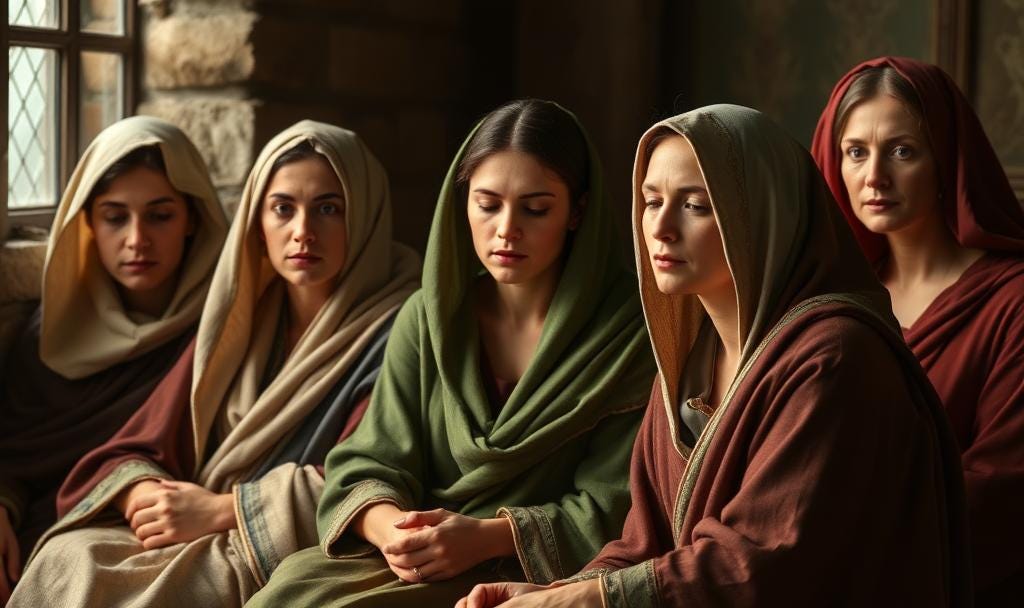
It’s one thing to span the several millennia of the Old Testament to make a case for women in leadership and ministry (Chapter 2). It’s quite another to compress the short period of Jesus’ ministry (roughly three years) and find a treasure trove of examples where women stood out as followers of Jesus alongside men. In his exploration of the role of women throughout the Gospels and Romans 16, Payne does just that!
The women who stood out to me were Mary Magdalene, who witnessed the crucifixion and was the first to meet the risen Christ, emphasizing her pivotal role in the resurrection narrative. In a culture where women’s testimonies were not considered legally valid, Jesus chose women as the first witnesses and proclaimers of the resurrection—the cornerstone of Christian faith. This choice carries profound theological implications regarding women’s role in spreading the gospel message.
Payne delves into the encounter between Jesus and the Samaritan woman at the well, emphasizing how their dialogue addressed intricate theological themes and reshaped her perspective on faith. This interaction was revolutionary in a culture where such discussions were typically limited to men. Furthermore, she emerged as a pivotal figure in sharing the message of faith within her community. In a similar vein, Jesus commended Mary of Bethany for choosing to sit at his feet and engaging in theological conversation. This privilege was generally reserved for male disciples of rabbis (Luke 10:38-42).
Furthermore, he emphasizes women's vital role in financially supporting Jesus' ministry, highlighting their essential contribution to His mission (cf. Luke 8:1-3). These women were not merely bystanders but active participants who advanced Jesus' mission through their resources and involvement. These were a diverse group of individuals who significantly aided in spreading His teachings, showcasing their influence and commitment. Throughout his analysis, Payne clearly illustrates that women were not just passive figures; they had a strong presence and played critical roles in shaping the early Christian narrative. This sheds light on their considerable impact on Jesus' life and the broader context of the Gospels. As New Testament scholar Ben Witherington pointed out, such involvement would have been culturally "unheard of and scandalous in Jewish circles" and "highly unlikely to have been fabricated by a Christian community" in the early centuries of the church (see footnote #3 in the book).
As we move to Romans 16, we encounter Paul’s greetings, which reveal a surprising diversity of women in leadership positions within the early church. Phoebe is introduced as a church deacon at Cenchreae and a “prostatis” (Gk.) (benefactor or patron) of many, including Paul himself (Romans 16:1-2). The Greek term diakonos used here is the same term applied elsewhere for church leaders, indicating an official role rather than merely someone who serves in a general way.
A particular figure in the early church is Junia, whom Paul describes as “outstanding among the apostles” (Romans 16:7). While earlier translations often masculinized her name to “Junias,” current scholarly consensus recognizes it as distinctly female. This recognition highlights women's prominent leadership roles in the early church, including within the apostleship. Additionally, Paul refers to Priscilla—mentioned before her husband Aquila—as his “co-worker in Christ Jesus” who risked her life for him (Romans 16:3-4). Together, they hosted a house church, and Priscilla actively taught theology when she instructed Apollos (Acts 18:26).
The presence of women like Mary, Tryphena, Tryphosa, and Persis, whom Paul describes as “workers in the Lord” (Romans 16:6, 12), indicates that women’s leadership and service were not exceptions but typical aspects of early church life. The term Paul uses to characterize these women’s work (kopiao in Greek) is the same one he utilizes elsewhere for gospel ministry and leadership. This biblical evidence suggests that women’s involvement in ministry was not merely permitted but essential to the spread and establishment of early Christianity. The Gospels and Romans 16 examples illustrate how women participate in teaching, evangelism, church leadership, and apostolic ministry, providing vital context for understanding women’s roles in ministry today.
Based on this survey of women in the gospels and Romans 16, Payne is building a compelling case for women as full participants in church leadership and ministry. Of course, there is still much ground to cover in the New Testament, and the issues do become rather complex in some of Paul’s letters. However, the extensive amount of material the author provides in this chapter sets the stage for a more profound critique and re-evaluation of the role of women within the church.
If I may, I share here an article I wrote about the claim that there are no female pastors in the New Testament: https://vidaemabundancia.blogspot.com/2025/03/nao-ha-pastoras-no-novo-testamento.html?m=0 (The article is in portuguese, but you may activate the automatic translation at the right top menu.)